
Alright, buckle up, stargazers! It’s time for a deep dive into the cosmic tapestry of our universe.
🏆 Find Best ‘Stars’ on AliExpress
* Discover top-rated items at AliExpress
Did you know that within our very own Milky Way galaxy, nestled amongst billions of stars, lie vibrant nurseries where new stars are born? These stellar cradles, swirling with gas and dust, are where the magic happens. And one of the most captivating of these cosmic birthing centers is the IC 348 nebula. Thanks to recent, breathtaking images released by NASA, we have a fresh perspective on this celestial wonder. Let’s embark on a journey to uncover the fascinating story the IC 348 nebula has to tell us about the lives of stars – and specifically, the unique characteristics of what we can call IC Stars, born within this special region.
Unveiling IC 348: A Stellar Genesis
The IC 348 nebula resides within the sprawling Perseus Molecular Cloud, approximately 1,000 light-years away, making it a relatively close neighbor in cosmic terms. This nebula is home to a young cluster of stars known as an open cluster. It’s an invaluable site for astronomers seeking to understand the intricate processes of stellar birth and evolution. Think of it as a cosmic delivery room, constantly churning out brand-new stars! But how do stars actually come into being, and what makes the IC 348 nebula so important for understanding these processes?
Stars are born from the interstellar medium—the gas and dust that permeates space. Gravity acts as the sculptor, drawing this material together. As the cloud collapses, it heats up, eventually igniting nuclear fusion at its core, birthing a brand-new star. The IC 348 nebula provides a front-row seat to witness this grand cosmic spectacle in action. The process, known as gravitational collapse, is the fundamental mechanism behind stellar birth.
Astronomers have studied the IC 348 nebula for decades, gleaning invaluable information from past observations and theoretical models. However, the latest high-resolution images from NASA’s cutting-edge telescopes have revealed details previously unimaginable. These images offer unprecedented clarity of the disks and jets structures surrounding young stars, as well as the complex forms of the interstellar medium. This breakthrough not only significantly enhances our understanding of star formation but also contributes to expanding our knowledge of the origin and evolution of the universe. This area of study is not just about understanding individual stars, but also the bigger picture: how galaxies evolve and how the universe itself changes over time. For more in-depth information on the Perseus Molecular Cloud where the IC 348 nebula is located, check out NASA’s dedicated webpage.
Why IC 348 Stands Out: A Prime Star-Forming Locale
So, what makes the IC 348 nebula so special? Several factors contribute to its significance:
- Proximity: Its relative closeness to Earth makes it easily observable for astronomers using a variety of telescopes, allowing for more detailed and frequent observations.
- Stellar Diversity: It contains stars of varying ages and evolutionary stages, making it ideal for studying the entire life cycle of a star. This allows scientists to observe stars at all different points in their development, which is crucial for understanding the full process of stellar evolution.
- Tranquil Environment: Compared to other star-forming regions, the IC 348 nebula is relatively quiet, allowing for detailed observation of the initial stages of star birth. This quiet environment provides a less chaotic setting to study the subtle processes that occur during the early stages of star formation.
The interstellar medium that comprises the IC 348 nebula consists primarily of hydrogen and helium, along with trace amounts of dust and other molecules. These dust particles play a vital role by absorbing and scattering light, creating the nebula’s captivating colors. The density of the interstellar medium is not uniform throughout the nebula, with denser regions being more prone to gravitational collapse, increasing the likelihood of new star formation. This difference in density creates different regions that form stars at varying rates, leading to the diversity we see in the cluster.
The stars within the IC 348 nebula exhibit a wide range of ages. The youngest stars are just emerging from their protostar phase and entering the main sequence, while the older stars are already stable and shining brightly. By analyzing this age distribution, we can estimate the rate and conditions under which stars are born. This stellar census provides important data about the efficiency of star formation in the IC 348 nebula.
Compared to other star-forming regions, the IC 348 nebula presents some unique characteristics. For instance, the Orion Nebula is far more active, hosting a greater number of young stars. In contrast, the Taurus Molecular Cloud is quieter, primarily forming low-mass stars. These comparisons help us understand how the environment shapes star formation, and why IC Stars in the IC 348 nebula might differ from stars in other stellar nurseries.
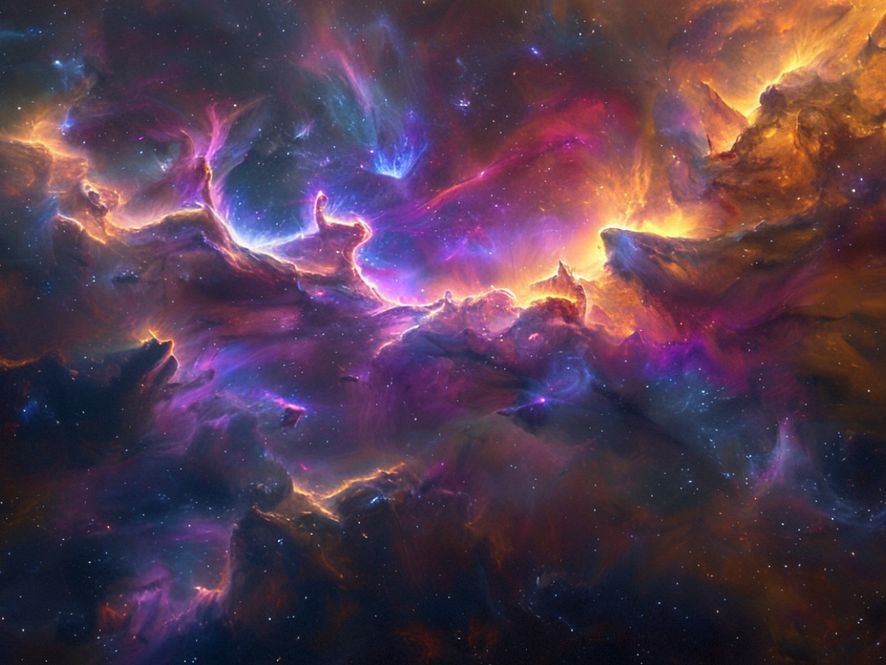
NASA’s Revelations: Discovering Hidden IC Stars
The stunning images of the IC 348 nebula released by NASA were captured using state-of-the-art telescopes: the Hubble Space Telescope and the James Webb Space Telescope. The Hubble Space Telescope provides exceptional resolution in the visible light spectrum, while the James Webb Space Telescope penetrates dust clouds in the infrared spectrum, allowing for detailed observation of star formation. These instruments have unveiled previously unseen aspects of the IC 348 nebula. The combination of visible and infrared light observations is crucial for a complete understanding of the nebula.
Let’s review some of the tools used to make these amazing discoveries:
| ✅ Pros | ❌ Cons |
|---|---|
| High-resolution imaging | Extremely high operating costs |
| Multi-wavelength observation | Atmospheric interference (for ground based telescopes) |
| Unobstructed space observation | Difficult repairs & upgrades |
The Hubble Space Telescope, launched in 1990, has been a workhorse for astronomers for decades, providing unparalleled views of the cosmos. Its ability to capture high-resolution images in visible light has revolutionized our understanding of the universe. The James Webb Space Telescope (JWST), launched in 2021, is the successor to Hubble, designed to observe the universe primarily in the infrared. JWST’s ability to penetrate dust and gas clouds allows it to see objects that are invisible to Hubble. The technologies powering these telescopes are truly impressive, including advanced mirror designs, sensitive detectors, and sophisticated data processing systems.
The stars captured in these images display diverse colors and brightness levels. Blue stars are hot and young, while red stars are cooler and older. A star’s brightness correlates with its mass and temperature—brighter stars are more massive and hotter, while dimmer stars are smaller and cooler. The distribution of stars also reveals crucial information: densely packed regions signify active star formation, while scattered regions indicate relative stability. Astronomers can use this information to map the star-forming activity within the IC 348 nebula.
One of the significant discoveries made through NASA’s analysis of the IC 348 nebula is the presence of brown dwarfs. These celestial objects blur the line between stars and planets, lacking the mass needed to sustain nuclear fusion and generate their own light. Traditionally challenging to observe, the James Webb Space Telescope’s infrared capabilities have confirmed their existence within the IC 348 nebula. This finding significantly contributes to our expanding understanding of star formation. Brown dwarfs, sometimes called “failed stars,” are more common than previously thought, and their presence in star-forming regions like IC 348 helps scientists refine their models of star formation.
The Power of Infrared: Signals from Hidden Stars
Infrared observation is incredibly valuable when studying regions like nebulas, which are rich in dust and gas. Infrared light, with its longer wavelength, can penetrate dust more effectively than visible light. It’s akin to using fog lights on a car to see better in foggy conditions. The James Webb Space Telescope maximizes this infrared observation capability, revealing hidden stars and their surroundings within the IC 348 nebula with unprecedented clarity, offering insight into the history of IC Stars. The IC 348 nebula is a prime example of why infrared astronomy is so important for studying star formation. Without it, we would only see a fraction of the stars being born within the nebula.

The Star Formation Mechanism: Lessons from IC 348
How does a star actually form? Star formation begins with gravitational collapse. The interstellar medium scattered throughout space gradually clumps together under the force of gravity. Regions with higher density attract more surrounding material, growing larger and hotter. Eventually, the core temperature rises high enough to initiate nuclear fusion, and a star is born.
Within the IC 348 nebula, every stage of this process can be observed. In some areas, we can witness the initial clumping of interstellar medium, while in others, protostars are already forming, accreting material from their surroundings. Furthermore, some stars are ejecting jets, a phenomenon where some of the energy produced during star formation is released outward. These jets can interact with the surrounding gas and dust, further shaping the nebula.
Our understanding of star formation continues to advance through comparative analysis of theoretical models and actual observational data. While theoretical models predict the process mathematically, observational data often reveal new phenomena that models cannot account for. By continuously comparing and refining these models, we can gain a more accurate understanding of the star formation mechanism in regions like the IC 348 nebula. This interplay between theory and observation is the cornerstone of modern astrophysics.
- Gravitational collapse: The process of interstellar matter clumping together under gravity. This initial stage is crucial for starting the process of star formation.
- Protostar formation: The phase where the clumped material gradually heats up, nearing the point of becoming a star. The protostar is not yet a true star, as it does not yet have nuclear fusion occurring in its core.
- Nuclear fusion: The stage when the core temperature rises high enough to initiate nuclear fusion. This marks the birth of a star.
- Planetary system birth: The phase when planets begin to form in the disk surrounding the star. This is a complex process that involves the accretion of dust and gas into larger bodies.
The Future of IC 348 Research: New Horizons in Space Exploration
The study of the IC 348 nebula is poised for even greater advancements. With the construction of next-generation telescopes like the Giant Magellan Telescope (GMT) and the Thirty Meter Telescope (TMT), we will be able to observe the IC 348 nebula with unprecedented detail. These telescopes will offer higher resolution and broader wavelength coverage, unveiling new insights previously unattainable.
The Giant Magellan Telescope (GMT), currently under construction in Chile, will have seven 8.4-meter mirrors, making it one of the largest optical telescopes in the world. The Thirty Meter Telescope (TMT), planned for construction in Hawaii (though facing some challenges), will have a single 30-meter mirror, providing even greater light-gathering power. These telescopes will allow astronomers to study the IC 348 nebula in much greater detail, revealing the secrets of star formation with unprecedented clarity.
The potential discoveries from studying the IC 348 nebula are boundless. For example, we can further investigate how planets form within the disks surrounding stars and determine how a star’s mass and chemical composition influence the formation of its planetary system. We might even discover exoplanets within the IC 348 nebula and analyze their atmospheric compositions to assess their potential for harboring life.
The research of the IC 348 nebula is closely linked to the search for extraterrestrial life. The environment in which stars are born is intricately connected to the environment in which planets are formed, and a planet’s environment influences its habitability. By studying the IC 348 nebula, we can better understand the conditions that make a planet habitable and inform our strategies for searching for life beyond Earth. This makes the study of the IC 348 nebula particularly exciting, as it could hold clues to whether we are alone in the universe.
Conclusion: The Message from IC Stars
The exploration of the IC 348 nebula ignites our curiosity about the universe and the human spirit of discovery. Within this relatively small nebula, we find vital clues about star formation, evolution, and planetary system development. Furthermore, IC 348 nebula research contributes to the broader quest for extraterrestrial life.
The IC 348 nebula prompts us to consider fundamental questions: Where did we come from? Are we alone in the universe? Addressing these questions requires us to continuously develop new technologies, formulate innovative theories, and attempt new observations. The story of IC Stars is more than the story of formation; it’s a story of deep scientific exploration.
The research on the IC 348 nebula will undoubtedly continue. Driven by future generations of telescopes and observational techniques, we will uncover even more of the hidden facets of the IC 348 nebula. Using the knowledge gained from IC 348 nebula research, we can broaden our understanding of the origin and evolution of the universe, as well as the potential for life beyond our planet.
The tale told by IC Stars is far from over. With unwavering curiosity and a thirst for knowledge, we will continue to explore and learn, moving ever closer to unraveling the mysteries of the cosmos.
Want to learn more about the latest discoveries in the IC 348 nebula? Visit the NASA website for the latest images and research. Or, share your thoughts on the possibilities of finding life beyond Earth in the comments below! Let the journey to understand the mysteries behind IC Stars continue!


