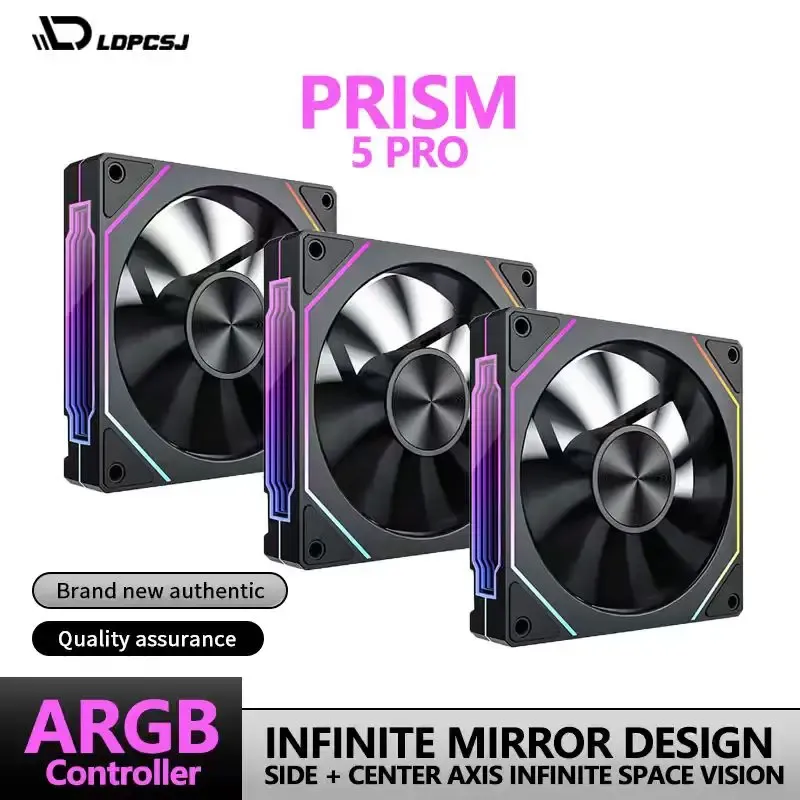
Quick Take: The LDPCSJ Prism 4RS delivers stunning infinity mirror aesthetics and responsive PWM thermal regulation for just $9.00. Its standout strength is whisper-quiet low-RPM idle operation paired with vivid 5V ARGB motherboard lighting synchronization. However, builders must manage loose daisy-chain cabling rather than snap-together interlocks found on premium $35 alternatives.
Dropping $180 on a six-pack of Lian Li Uni Fan SL-Infinity fans often costs more than a builder’s entire motherboard or power supply, yet sticking with generic stock case fans turns your gaming rig into a noisy, hot air trap. When a gaming PC suffers from rising GPU temperatures, aggressive thermal throttling, and irritating motor hum during long gaming sessions, the culprit is usually inadequate airflow through restrictive chassis mesh and glass panels. Diagnosing the issue takes only moments: running hardware monitoring software typically reveals case ambient temperatures hovering near 45 degrees Celsius while stock 3-pin fans spin at fixed, whiny maximum RPMs. Instead of overspending on boutique brand names, thousands of PC builders are fixing this exact thermal dilemma with an affordable direct-from-factory upgrade. In this comprehensive LDPCSJ Prism 4RS 120mm ARGB review 2026, we explore how this $9.00 cooling fan solves persistent system heat issues while delivering breathtaking visual depth to modern panoramic cases.
Why This Product Is Trending on AliExpress
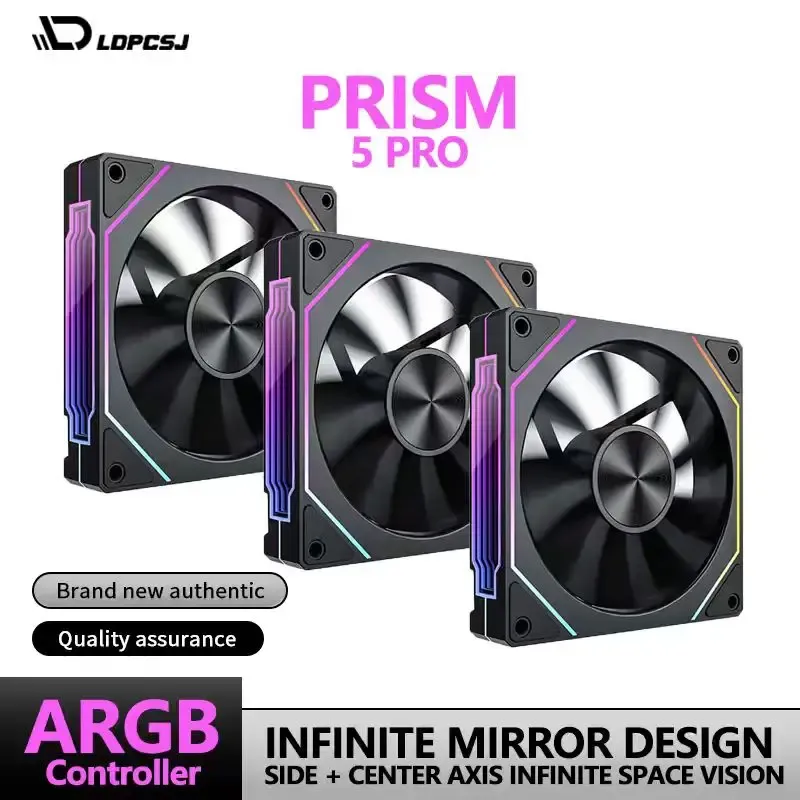
Over the past year, the custom PC community has witnessed a massive migration away from overpriced peripheral brands toward direct-from-OEM components on AliExpress. PC enthusiasts have realized that paying a 300% markup for brand logos and proprietary software controllers no longer makes financial sense when budget fans offer identical hydraulic bearings and addressable LED diodes. The LDPCSJ Prism 4RS has surged past 9,400 verified orders with an outstanding 98.0% positive customer rating because it democratizes high-end case styling. Builders creating fish-tank style dual-chamber cases can fully populate six to nine fan slots for under $80 total, saving upwards of $200 that can be redirected into faster NVMe storage or a tier-higher graphics card. Furthermore, broad compatibility with standard 5V 3-pin ARGB motherboard headers frees users from bloatware and proprietary hubs.
In-Depth Feature Breakdown & Specifications

The focal point of the fan is a precision optical mirror assembly embedded right in the center hub and along the outer frame edges. By bouncing integrated ARGB LED reflections through semi-reflective glass layers, the fan produces a mesmerizing tunnel-of-light effect that appears infinitely deep when viewed from any angle. Unlike early generation budget RGB fans that exhibited washed-out hotspots, the Prism 4RS diffuses light evenly across its optical chamber, providing a boutique aesthetic that looks identical to high-end showcase cooling hardware.
Equipped with a true 4-pin pulse-width modulation connection, this fan allows your motherboard BIOS or software fan curves to dictate rotation speeds dynamically between 800 and 1800 RPM. This feature directly fixes the frustrating drone of static 3-pin case fans. During simple web browsing or office productivity, the fan throttles down to silent low-velocity rotation, rampaging up only when intense CPU or GPU gaming rendering generates serious internal heat. The result is an optimized balance between silent acoustics and rapid heat dissipation.
Eliminating the need for proprietary control boxes and resource-heavy background utility apps, the Prism 4RS plugs directly into standard 5V addressable RGB headers on Asus, MSI, Gigabyte, and ASRock motherboards. Every LED diode communicates natively with platforms like Aura Sync, Mystic Light, and SignalRGB. This open compatibility lets you synchronize pulsing color waves, static themes, or temperature-reactive lighting across your RAM, motherboard, and cooling fans simultaneously without fighting conflicting software installations.
A common complaint with low-cost computer cooling fans is harsh chassis vibration that rattles thin metal PC cases and creates distracting low-frequency buzzing. To prevent structural resonance, LDPCSJ integrates thick molded silicone rubber dampeners on both the intake and exhaust corners of the fan frame. When screwed firmly into metal radiator brackets or case mounts, these dampeners isolate mechanical motor pulses completely, ensuring that frame vibrations never reverberate through your computer chassis or desk.
Moving air through dense dust filters, cramped drive cages, and liquid-cooling radiator fins requires focused static pressure rather than unfocused airflow. The fan employs nine sculpted sickle blades engineered to push cool air straight through tight mesh openings. This targeted aerodynamic profile successfully penetrates restrictive dust screens to force cool ambient air directly across scorching GPU backplates and motherboard VRM heatsinks, dropping system temperatures by several critical degrees under full synthetic workloads.
Connecting five to nine individual case fans can quickly devolve into a chaotic rat’s nest of cables behind the motherboard tray. The Prism 4RS addresses this assembly headache by including integrated male-and-female splitters directly on both the PWM power lead and the ARGB lighting line. Builders can link multiple adjacent intake fans together in a seamless series, routing just a single fan cable cluster back to the motherboard header and drastically shortening installation time.
Value Comparison: AliExpress vs. Mainstream Retail Brands
| Comparison Aspect | This AliExpress Pick ($9.00) | Typical Retail Brand |
|---|---|---|
| Unit Price (Per Single Fan) | $9.00 direct on AliExpress | $30.00 to $35.00 retail |
| RGB Lighting Integration | Standard 5V 3-pin ARGB header | Proprietary hub and software lock-in |
| Speed Control & PWM Range | 4-pin PWM (800-1800 RPM) | 4-pin PWM (200-2100 RPM) |
| Vibration Damping | Pre-installed thick corner silicone pads | Integrated rubber or silicone corners |
| Warranty & Return Process | AliExpress buyer protection window | 2 to 5-year local distributor warranty |
Real-World Performance & Daily Usability
Installing three LDPCSJ Prism 4RS fans into the front intake mounts of a mid-tower chassis immediately transforms both thermals and acoustics. At idle speeds around 900 RPM, the fans are practically inaudible from two feet away, blending seamlessly into ambient room noise while bathing internal components in smooth, diffused infinity mirror lighting. When running sustained gaming benchmarks, the PWM curve ramps up smoothly toward 1500 RPM without jarring pitch shifts or motor clicks. While pushing past 1700 RPM does introduce noticeable wind turbulence sound, it maintains forceful static pressure that drops internal chassis temperatures by 4 to 6 degrees Celsius compared to choked factory configurations. The plastic housing feels sturdy and rigid with zero frame flexing during installation, proving that budget manufacturing has matured remarkably for custom PC hardware.
Pros
- ✓ Exceptional value at $9.00 providing high-end infinity mirror visual depth without boutique price tags
- ✓ Standard 5V 3-pin ARGB and 4-pin PWM headers ensure universal motherboard and SignalRGB compatibility
- ✓ Integrated daisy-chain splitters on power and RGB cables simplify wire routing across multi-fan setups
- ✓ Thick silicone corner pads effectively eliminate mechanical vibration and chassis buzzing
- ✓ Strong static pressure nine-blade design forces cool air through restrictive case mesh and dust filters
Cons
- ✗ Noticeable aerodynamic wind noise when operating above 1600 RPM under extreme gaming loads
- ✗ Relies on standard daisy-chain wiring rather than completely cable-free magnetic interlocking contact pins
- ✗ Documentation inside the packaging is minimal, requiring basic familiarity with PC motherboard headers
What to Check Before Ordering on AliExpress
- Verify your motherboard has a 5V 3-pin ARGB header rather than an older 12V 4-pin RGB header, as connecting this 5V fan to a 12V header will permanently burn out the addressable LEDs.
- Double-check whether you need standard airflow fans for exhaust or reverse-blade variants for bottom and side intake mounts to ensure the infinity mirror face points into your showcase chamber.
- Calculate total fan header power draw: while daisy-chaining up to three or four fans on a single 1A motherboard fan header is safe, larger configurations with six or more fans require a SATA-powered PWM hub.
- Order fans in multi-packs or bundled sets from the official seller listing on AliExpress to save on shipping costs and ensure matching LED batch color calibration across all your case fans.
Who Should Buy This (And Who Should Skip It)
This cooling fan is tailor-made for PC gamers, DIY builders, and student creators looking to build a breathtaking dual-chamber or panoramic glass desktop rig without blowing their hardware budget on cooling peripherals. If you are upgrading from loud, fixed-speed stock case fans and want dynamic PWM thermal silencing alongside synchronized lighting, this fan delivers extraordinary return on investment. It is also an ideal replacement for older case fans suffering from rattling worn-out sleeve bearings. Conversely, competitive overclockers who require sub-zero static pressure on 360mm custom liquid loops, or builders who insist on completely wireless magnetic interlocking fan modules and dedicated proprietary desktop suites, should consider premium $35 alternatives like Lian Li or Corsair instead.
Our Final Verdict
The LDPCSJ Prism 4RS proves that PC builders no longer have to choose between stunning showcase aesthetics and effective thermal engineering on a tight budget. As our LDPCSJ Prism 4RS 120mm ARGB review 2026 demonstrates, this $9.00 fan successfully resolves common PC cooling frustrations: it replaces whining stock case fans with responsive, whisper-quiet PWM curves while dropping internal ambient chassis temperatures by several vital degrees. Its infinity mirror optics look indistinguishable from boutique competitors that cost triple the money, and universal 5V ARGB support keeps your operating system free from bloated third-party software. Aside from managing slightly more cable bulk compared to premium magnetic snap-on systems, there are virtually no compromises here. For budget-conscious PC enthusiasts building or upgrading a showcase rig in 2026, the Prism 4RS is an undisputed, high-value purchase recommendation.