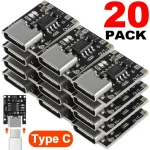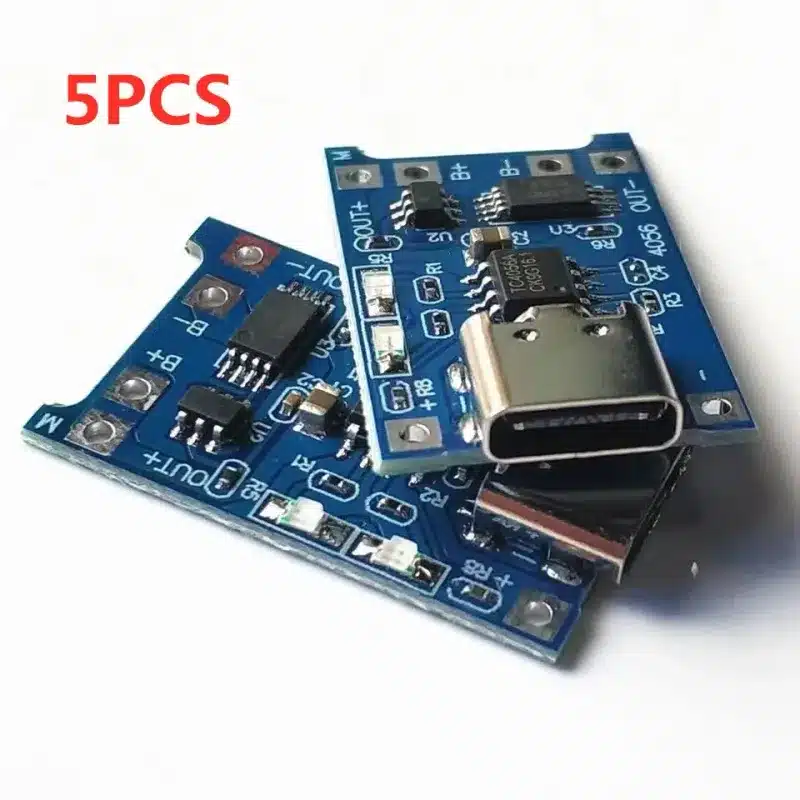
Quick Take: This $2.75 multi-pack TP4056 5V 1A charger module is an unbeatable budget staple for DIYers converting 18650-powered gadgets to rechargeable USB power. Its standout strength is combining regulated 1A lithium charging with built-in over-discharge protection in one tiny PCB, though you must supply your own soldering tools and verify connector variants carefully.
Skip paying five dollars per board at domestic hobby shops for a circuit that originates on the exact same electronics assembly line. Picture sitting at your workbench on a Sunday afternoon with a dead portable radio, a salvaged 18650 laptop cell, and a pile of tangled legacy cables, wishing you could turn that disposable-feeling gadget into a clean, USB-rechargeable workhorse for spare change. That exact scenario explains why this 5V 1A TP4056 lithium battery charger module has quietly racked up 10,492 orders and a 96.4% positive rating on AliExpress at just $2.75 per pack, marked down 54% from $6.10. In this 2 5PCS 5V 1A Micro review 2026 guide, we break down how its dual-function charging and protection architecture actually works, where bargain-bin expectations meet physical limits, and whether this miniature PCB belongs in your parts bin.
Why This Product Is Trending on AliExpress
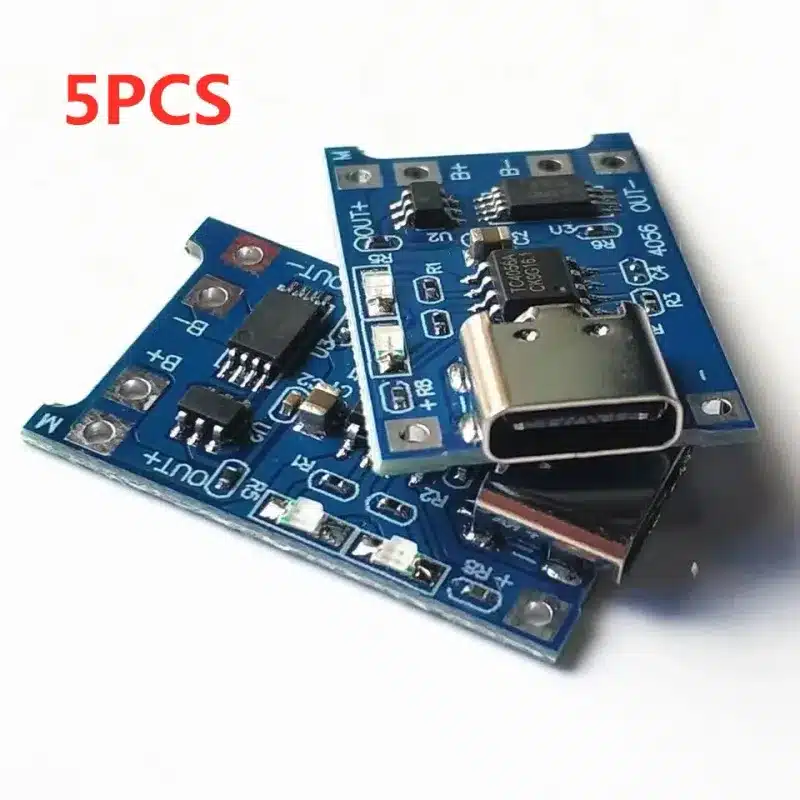
Smart makers and repair hobbyists are driving massive demand for these boards because big-box electronics retailers and domestic hobby marketplaces routinely charge $7 to $15 for two or three identical TP4056 breakout boards once branding and warehouse margins are tacked on. At $2.75 for a multi-pack bundle, buyers cut component costs by 60 to 80 percent while gaining the exact same linear charging controller used across millions of budget consumer electronics. Beyond raw savings, the ongoing household transition away from aging Micro-USB and Mini-USB cords toward universal USB Type-C cables has fueled a wave of retrofitting projects. Enthusiasts are snapping up multi-packs to modernize older Bluetooth speakers, headlamps, handheld fans, and microcontroller enclosures without discarding perfectly functional hardware.
In-Depth Feature Breakdown & Specifications
Unlike barebones charger boards that only regulate incoming 5V power, this dual-function design pairs the TP4056 charging controller with dedicated battery protection circuitry. While charging, it follows a constant-current, constant-voltage curve tailored for single-cell 3.7V lithium-ion batteries up to 4.2V. During discharge, the secondary protection stage monitors cell voltage and load current, cutting off output before deep over-discharge or accidental short circuits permanently ruin your 18650 battery.
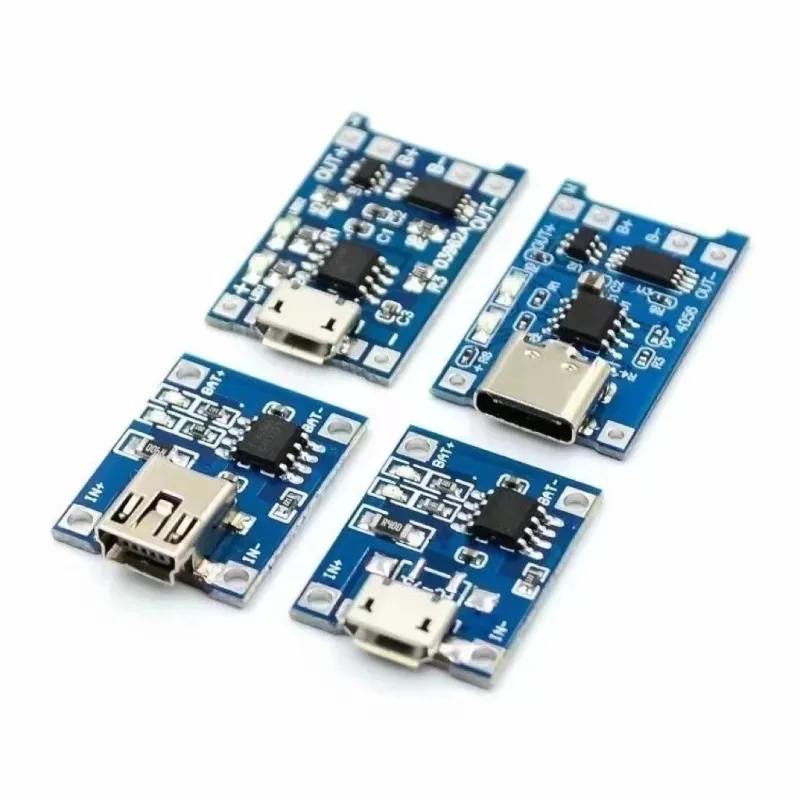
Listings let you match the input jack to your project rather than forcing an awkward adapter onto an existing enclosure. Choosing the Type-C option makes modernizing older battery compartments effortless with the same cable that charges your phone, whereas Micro-USB and Mini-USB options drop straight into legacy repair slots. Having all three footprints available under one listing saves builders from hunting across separate vendors for mismatched stock.
Delivering up to 1A from any standard 5V USB wall brick, power bank, or computer port hits the sweet spot for common 18650 cylindrical cells. Because 1A represents a gentle charge rate for standard 2000mAh to 3500mAh cells, batteries avoid the excessive stress caused by aggressive fast-charging circuits. Even better, the simple linear topology avoids high-frequency switching noise that can otherwise interfere with sensitive DIY audio preamps or radio receivers.
Buying a single charging module rarely makes sense once you factor in shipping wait times and the reality of DIY soldering mishaps. Offering 2-piece and 5-piece packs at $2.75 brings the effective cost per protected charger well under a dollar, giving tinkerers spare boards for future projects or accidental reverse-polarity mistakes. Stocking a few extras turns impulse weekend repairs from annoying waiting games into quick ten-minute fixes.
Clearly separated solder pads allow clean separation between the charging cell and the device drawing power. You solder the lithium cell leads to the battery terminals and wire your project load to the protected output pads, ensuring your attached electronics benefit from low-voltage cutoff too. Having exposed through-hole pads alongside the USB jack also lets builders wire an external charging port or solar panel input directly onto the board.
Value Comparison: AliExpress vs. Mainstream Retail Brands
| Comparison Aspect | This AliExpress Pick ($2.75) | Typical Retail Brand |
|---|---|---|
| Price Per Multi-Pack | $2.75 for multi-pack bundle | $8-$15 for 2-5 retail boards |
| Battery Protection | Integrated over-discharge and short guard | Often sold as charger-only PCB |
| Connector Selection | Micro, Type-C, or Mini options | Usually single fixed port SKU |
| Documentation & Support | Minimal silkscreen labels only | Full datasheets and US support |
| USB-C PD Compatibility | Best with USB-A to C cables | Better native C-to-C compliance |
Real-World Performance & Daily Usability
In everyday workbench use, this board performs exactly as seasoned electronics tinkerers expect from a genuine TP4056 linear module, provided you respect its thermal and electrical boundaries. When charging a depleted 18650 cell at the full 1A rate, the primary IC runs noticeably warm to the touch because linear regulators dissipate excess voltage between the 5V USB supply and the battery’s current voltage as heat. Giving the board modest breathing room inside your housing keeps temperatures entirely manageable, though sealing it tightly in hot foam insulation is asking for thermal throttling. Status indicator LEDs make troubleshooting effortless at a glance, showing charging progress and full termination clearly without requiring a multimeter every five minutes. One quirk worth noting on budget Type-C variants is cable negotiation: while standard USB-A-to-USB-C cables deliver steady 5V power every time, certain ultra-cheap boards omit the configuration resistors required to wake up smart USB-C Power Delivery bricks. Once soldered cleanly with solid 22AWG leads, longevity across intermittent repair projects and low-power sensor nodes is surprisingly dependable.
Pros
- ✓ Unbeatable multi-pack pricing at $2.75 delivers genuine linear charging and protection for pennies per board
- ✓ Dual-function protection stage guards expensive 18650 cells against over-discharge and accidental output shorts
- ✓ Selectable Type-C, Micro-USB, and Mini-USB options simplify both new builds and legacy gadget retrofits
- ✓ Proven track record backed by 10,492 orders and a 96.4% approval score, though buyers must still inspect solder joints on arrival
Cons
- ✗ Requires soldering skills, hookup wire, and careful polarity checks since there are no plug-in JST sockets or protective cases
- ✗ Type-C variant often fails to negotiate 5V from smart C-to-C PD chargers, requiring a traditional USB-A-to-C cable
- ✗ Linear 1A charging generates noticeable heat during bulk charge phases and lacks consumer safety certifications for unattended enclosures
What to Check Before Ordering on AliExpress
- Double-check the seller’s variant selector before checkout so you choose the exact port type (Type-C, Micro, or Mini) and pack count (2PCS vs 5PCS) you actually want.
- Verify that your battery is a standard 3.7V nominal (4.2V max) Li-ion or LiPo cell; never use this 4.2V TP4056 board for 3.2V/3.65V LiFePO4 batteries.
- Test the Type-C version with a standard USB-A-to-USB-C cable and 5V phone brick first if a dual-ended USB-C laptop charger fails to light up the status LED.
- Always confirm B+ and B- battery polarity with a multimeter before soldering—reversing leads even for a split second will instantly destroy the protection MOSFETs.
Who Should Buy This (And Who Should Skip It)
Weekend electronics DIYers who want to convert AA-powered desk lamps, vintage portable radios, or handheld fans to rechargeable 18650 power will get tremendous mileage out of a 5-pack. Arduino and ESP32 hobbyists building weather stations, smart home sensors, or small robotics prototypes will also appreciate having low-cost protected power modules ready on demand, alongside repair-minded shoppers refreshing worn-out Bluetooth speakers or camping flashlights. On the other hand, complete beginners who do not own a soldering iron—or anyone seeking a plug-and-play consumer battery bay or high-current multi-cell power bank board—should skip this bare PCB and buy an enclosed bay charger or dedicated buck-boost BMS instead.
Our Final Verdict
Wrapping up our 2 5PCS 5V 1A Micro review 2026 evaluation, this compact TP4056 module easily earns a spot in any maker’s drawer as one of the highest-utility sub-three-dollar purchases on AliExpress. Its combination of steady 5V 1A lithium charging, built-in battery protection, and flexible USB connector choices delivers performance indistinguishable from branded hobby boards costing three to five times more. Of course, it is not a consumer appliance: you have to bring basic soldering competence, respect linear heat dissipation, and keep a USB-A-to-C cable handy for Type-C builds. Provided you want dependable single-cell Li-ion power management without retail markups, buying the 5-pack at $2.75 while the 54% discount holds is an easy, practical recommendation for 2026 DIY builders.