
A Dance of Galaxies: Unraveling the Cosmic Ballet of NGC 4490 and NGC 4485
Did you know that the universe is a stage for a never-ending cosmic ballet? Galaxies, those colossal islands of stars, gas, and dust, are not static entities suspended in space. They are dynamic systems, constantly interacting, colliding, and merging, shaping the very fabric of the cosmos in a breathtaking spectacle of gravitational forces. This constant interplay, known as galaxy interaction, is a fundamental process in shaping the universe as we know it. Among these celestial performances, the interaction between two galaxies, NGC 4490 and NGC 4485, stands out as a particularly captivating example of A Dance of Galaxies. Think of it as a cosmic tango, where gravitational forces lead to a beautiful, albeit destructive, embrace. It’s a dance with consequences, a transformation written in the language of light and gravity.
🏆 Find Best ‘Dance Galaxies’ on AliExpress
* Discover top-rated items at AliExpress
Introduction: The Profound Importance of Galaxy Interaction
Galaxy interactions are not merely cosmic accidents; they are fundamental drivers of galaxy evolution. When galaxies collide, the gravitational forces at play can trigger dramatic bursts of star formation, reshape galactic structures, and even transform one type of galaxy into another. This process of galactic merger is akin to a cosmic sculptor, patiently reshaping galaxies over millions, even billions, of years. Think of it as a cosmic makeover, where galaxies undergo radical transformations through these encounters. Understanding these interactions is crucial for piecing together the history of the universe, like archaeologists deciphering ancient texts to understand lost civilizations. Without this understanding, our cosmic history remains incomplete.
NGC 4490 and NGC 4485 are a system that vividly demonstrates galaxy interaction. These relatively small galaxies, locked in a gravitational embrace, offer astronomers a unique opportunity to study the processes that govern galactic evolution on a more intimate scale. These are dwarf galaxies, significantly smaller and less massive than our own Milky Way, making their interactions easier to observe and model. Unlike massive galaxy mergers, the interaction between NGC 4490 and NGC 4485 allows us to observe the subtle, yet profound, effects of gravitational forces on less massive systems. The relative proximity of these galaxies, at approximately 24 million light-years away, also makes them an ideal laboratory for studying tidal interactions, a key element in galaxy evolution.
This article aims to delve into the fascinating dynamics of this Dance of Galaxies, shedding light on the significance of this galaxy interaction and summarizing the key findings of astronomical research conducted on this system. We will explore the individual characteristics of each galaxy, the evidence of their ongoing interaction, the resulting burst of star formation, and the implications of studying this system for our understanding of galactic evolution. In essence, we’ll be dissecting the steps of this cosmic dance, examining each movement and pose to understand the narrative it tells about the universe.
NGC 4490 and NGC 4485: Individual Profiles in this Dance of Galaxies
To truly appreciate the cosmic dance between NGC 4490 and NGC 4485, we must first understand the individual characteristics of each galaxy. Understanding their individual histories, their masses, their shapes, and their compositions helps us decipher the impact of their interaction. Imagine trying to understand a relationship without knowing the backgrounds of the individuals involved – it would be impossible!
NGC 4490, also known as the Cocoon Galaxy, is a barred spiral galaxy characterized by its distinctive, warped shape. It’s estimated to be approximately 80,000 light-years across, making it somewhat smaller than our own Milky Way. Its mass is estimated to be around 10 billion times the mass of our Sun. The “barred” designation refers to the central bar-shaped structure composed of stars, which channels gas inward, fueling star formation. This bar acts like a cosmic pump, drawing in raw materials for stellar nurseries.
NGC 4485, on the other hand, is an irregular galaxy, significantly smaller than its partner. Its size is estimated to be around 20,000 light-years across, and it possesses a more chaotic and disturbed structure. These types of galaxies are called dwarf galaxies. These smaller galaxies often lack a well-defined structure and are thought to be more susceptible to the gravitational influence of larger galaxies. They are often seen as satellite galaxies, orbiting larger systems.
Estimating the original forms of each galaxy before their interaction is challenging, but astronomers believe that NGC 4490 was likely a more regular spiral galaxy, while NGC 4485 may have been a smaller, less structured dwarf galaxy. Their interaction has significantly altered their morphologies, resulting in the distorted shapes we observe today. This distortion is a direct consequence of the ongoing galaxy interaction. Like a clay sculpture being reshaped by a powerful hand, these galaxies have been molded by gravity.
These galaxies reside within the constellation Canes Venatici (사냥개자리 – Hunting Dogs), at a distance of approximately 24 million 광년 (light-years) from Earth. Their proximity makes them relatively easy to observe, allowing astronomers to study their interaction in detail. The fact that we can observe them in such detail underscores their importance in understanding galactic mergers.
The history of observing these galaxies dates back to the late 18th century, when they were first cataloged by William Herschel. Since then, they have been the subject of numerous astronomical studies, using a variety of telescopes and observational techniques to unravel the mysteries of their interaction. Early observations were limited to visual inspections, noting only their positions and basic shapes. Modern observations, however, utilize advanced techniques, like spectroscopy and radio astronomy, to study the galaxies in detail. Spectroscopic analysis allows astronomers to determine the chemical composition and velocities of stars and gas, while radio observations reveal the distribution of neutral hydrogen, a key ingredient in star formation.
Evidence of Galaxy Interaction: Structural Distortion and Tidal Tails in this Dance of Galaxies
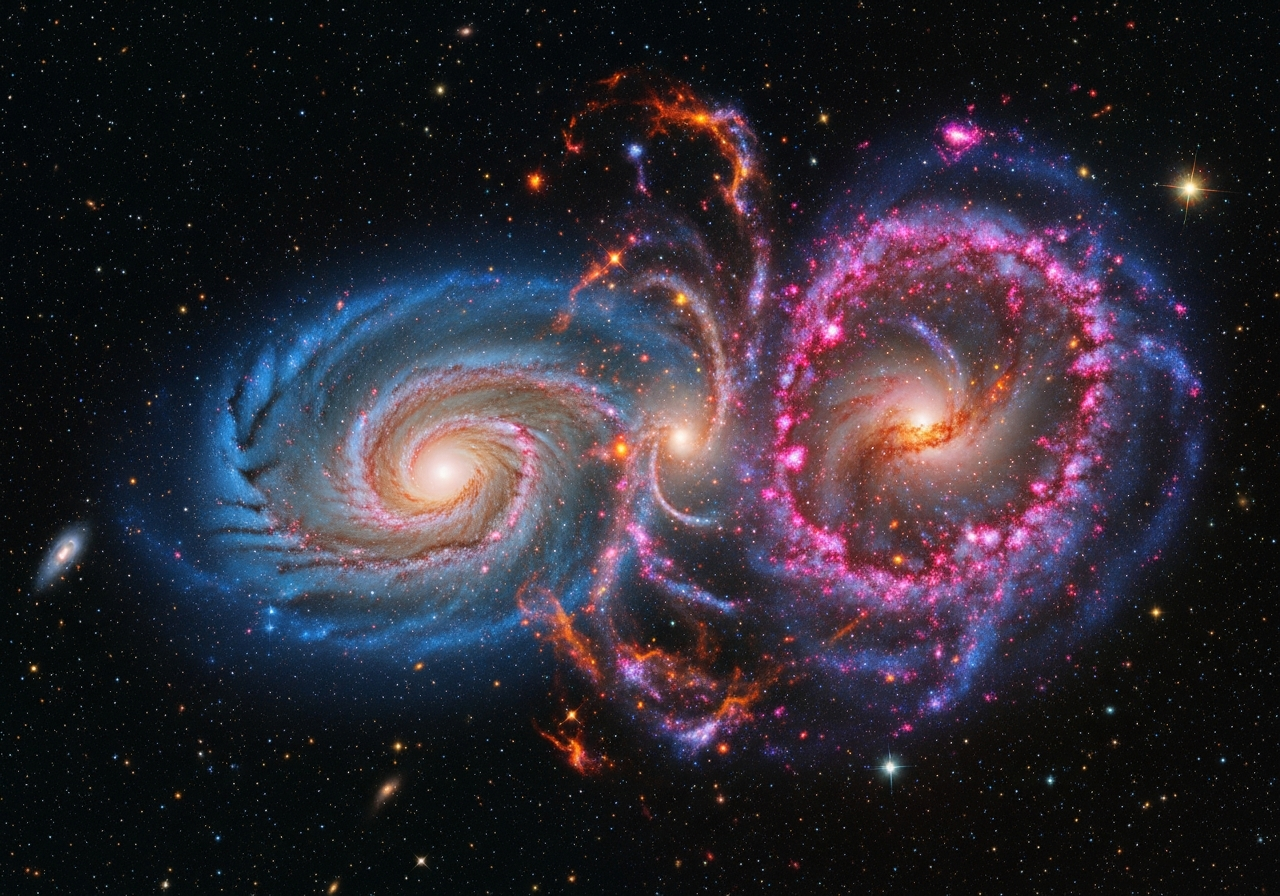
The most striking evidence of the galaxy interaction between NGC 4490 and NGC 4485 is the dramatic structural distortion visible in their images. NGC 4490, in particular, exhibits a highly warped and asymmetric shape, deviating significantly from the regular spiral structure. This warping is a direct consequence of the tidal forces exerted by NGC 4485. These distortions are telltale signs of gravitational disruption. It’s as if an invisible hand has reached out and twisted the galaxy, leaving it forever changed.
조석력 (Tidal Force) occurs when the gravitational pull of one object on another is not uniform across the entire object. The side of the object closest to the gravitational source experiences a stronger pull than the far side, resulting in a stretching effect. In the case of NGC 4490 and NGC 4485, the tidal forces from NGC 4485 have distorted the shape of NGC 4490, pulling out material and creating the observed warping. This is similar to how the moon causes tides on Earth, albeit on a much grander scale. The differences in gravitational pull act like cosmic rubber bands, stretching and distorting the galaxies.
One of the most prominent features resulting from this interaction is the presence of a long, extended tidal tail emanating from NGC 4490. This tail is composed of stars, gas, and dust that have been ripped away from the galaxy by the gravitational forces of NGC 4485. The tail stretches out like a cosmic ribbon, marking the path of their interaction. It is a visible scar of their gravitational encounter.
The formation of a tidal tail is a complex process. Here is a breakdown of the key steps:
- The interaction begins: Galaxies approach each other, drawn together by gravity.
- Gravitational disruption: 조석력 (Tidal Force) distorts shapes, stretching and pulling at the galaxies.
- Material ejection: Stars, gas, dust are ejected from the galaxies, forming streams of debris.
- Tail formation: Material forms an extended structure, creating the distinctive tidal tail.
The analysis of data obtained at different 파장 (wavelengths) is a critical part of understanding the galaxy interaction. Radio observations reveal the distribution of neutral hydrogen gas, tracing the extent of the tidal tail and the regions where star formation is actively occurring. X-ray observations can identify hot gas and active galactic nuclei (AGN), providing insights into the energy output and dynamics of the system. Optical observations capture the visible light from stars and dust, revealing the structural details of the galaxies. Combining these different wavelengths provides a complete picture of the interaction. The technology behind this involves incredibly sensitive detectors, sophisticated data processing algorithms, and powerful telescopes, both ground-based and space-based. For example, the Atacama Large Millimeter/submillimeter Array (ALMA) allows astronomers to observe the distribution of molecular gas, the raw material for star formation, with unprecedented detail.
Promotion of Star Formation Activity: The Result of Collision in this Dance of Galaxies
Galaxy collisions are known to be potent triggers of star formation. The compression of gas clouds during the interaction can initiate gravitational collapse, leading to the birth of new stars. The NGC 4490/4485 system is no exception, exhibiting a significantly elevated 항성 형성률 (Star Formation Rate) compared to isolated galaxies. The increase in star formation is a direct consequence of the galaxy interaction. It’s a burst of cosmic creativity, sparked by the gravitational dance of these two galaxies.
The collision process directly impacts the ability of galaxies to create stars:
- Increased density: Gas clouds become denser as they are compressed by the interaction.
- Cloud collapse: Denser clouds collapse under gravity, overcoming internal pressure.
- Star birth: Collapsing clouds form new stars, igniting stellar nurseries.
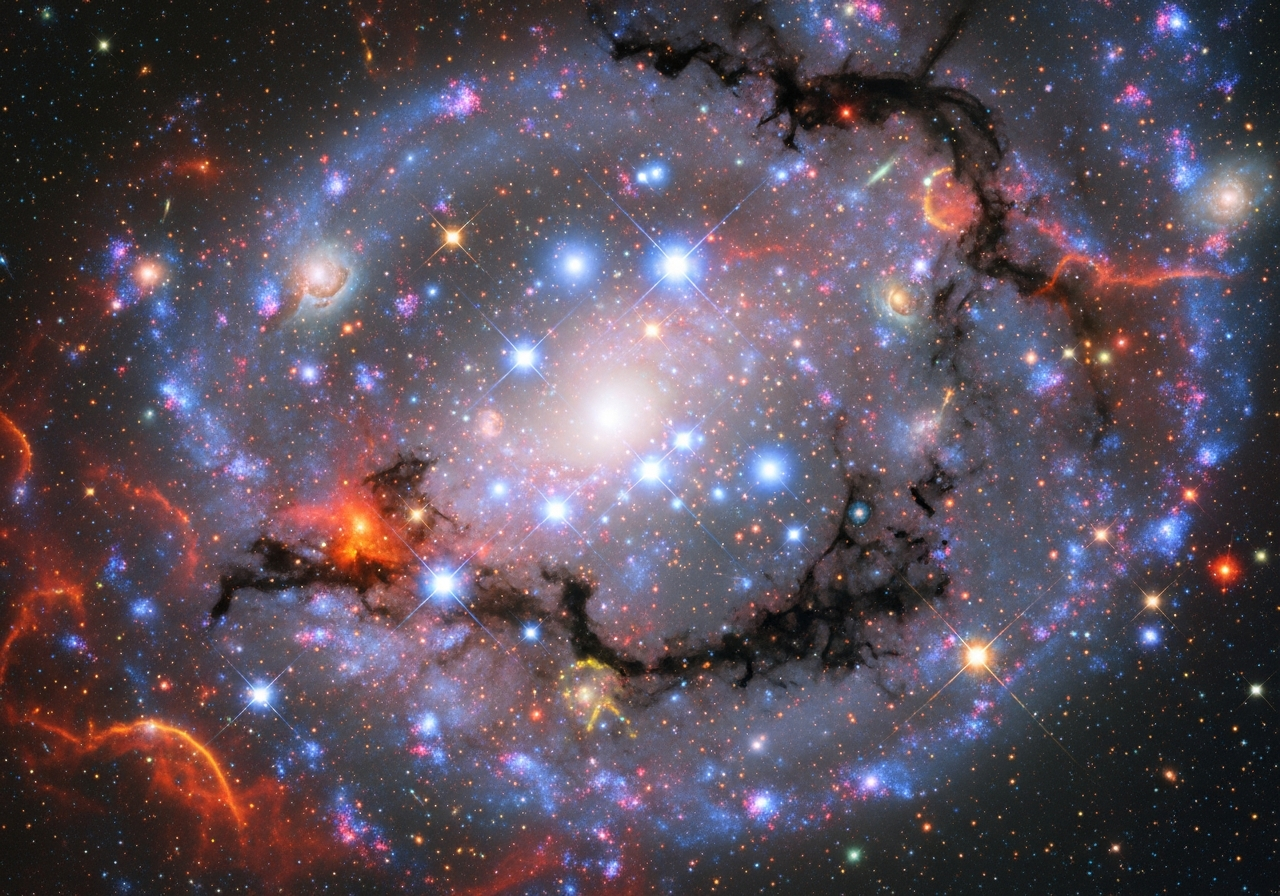
Within the NGC 4490/4485 system, astronomers have identified numerous regions of intense star formation, particularly within NGC 4490 and along the tidal tail. These regions are characterized by the presence of young, hot, and massive stars that emit large amounts of ultraviolet radiation, ionizing the surrounding gas and creating bright emission nebulae. These nebulae are visual markers of active star formation, glowing brightly in the surrounding darkness.
The enhanced star formation activity is not uniform throughout the system. The regions with the highest star formation rates are typically located where the gas density is highest, such as in the spiral arms of NGC 4490 and within the tidal tail. This suggests that the interaction has directly influenced the distribution and density of gas, triggering star formation in specific locations. The process is self-reinforcing: more gas compression leads to more star formation, which in turn heats and ionizes the surrounding gas.
The history of 항성 형성률 (Star Formation Rate) is an ebb and flow across galactic history:
- Early Universe: High rates due to gas availability, the early universe was rich in the raw materials for star birth.
- Galactic Evolution: Rates decline as gas is used, over time, galaxies consume their gas reserves, leading to a decrease in star formation.
- Mergers: Can briefly boost rates through compression, galaxy mergers can rejuvenate star formation by compressing gas clouds.
The ability to accurately measure the Star Formation Rate relies on sophisticated techniques, including measuring the intensity of hydrogen alpha emission lines and the ultraviolet flux from young stars. These measurements are then used to estimate the number of new stars being born in the galaxy. These techniques rely on the principles of spectroscopy, allowing astronomers to analyze the light emitted by stars and gas.
Significance as the Closest Dwarf Galaxy Interaction System: A Key Example in this Dance of Galaxies
The NGC 4490/4485 system holds particular significance as one of the closest and most well-studied examples of dwarf galaxy interactions. Its proximity allows astronomers to observe the interaction in exquisite detail, providing valuable insights into the processes that govern the evolution of these smaller galaxies. Studying these galactic mergers at close range allows us to understand the processes at play with unprecedented clarity. Imagine being able to study a complex chemical reaction in a large beaker, rather than trying to infer its behavior from distant observations.
Comparing the NGC 4490/4485 system with other interacting galaxy systems helps scientists understand the full spectrum of galaxy interactions:
- Massive galaxies: Mergers create ellipticals, when massive galaxies collide, they often merge to form elliptical galaxies.
- Dwarf galaxies: Disrupt and trigger star bursts, interactions between dwarf galaxies can disrupt their structure and trigger bursts of star formation.
- High 적색편이 (Redshift) galaxies: Gives early insights, observing galaxies at high redshift allows us to study the universe at earlier epochs, providing insights into galaxy formation and evolution.
The study of dwarf galaxy interactions is crucial for understanding the formation and evolution of larger galaxies. Dwarf galaxies are believed to be the building blocks of larger galaxies, merging over cosmic time to form the massive structures we observe today. By studying the interaction between NGC 4490 and NGC 4485, we can gain a better understanding of the processes that drive these galactic mergers and shape the evolution of galaxies. In essence, these dwarf galaxy interactions provide clues about the history of the universe and the formation of galaxies like our own Milky Way. They are like pieces of a cosmic puzzle, helping us to reconstruct the history of the universe.
Moreover, the detailed observations of this system provide valuable data for testing and refining modeling and simulations of dwarf galaxy collisions. These simulations help astronomers to understand the complex interplay of gravitational forces, gas dynamics, and star formation that occur during these interactions. The accuracy of these simulations depends on the quality of the observational data used to constrain them. Supercomputers are essential for running these complex simulations, allowing astronomers to model the intricate processes involved in galaxy interactions.
Looking ahead, future research will likely focus on obtaining even more detailed observations of the NGC 4490/4485 system, using advanced telescopes and observational techniques. These observations will provide a deeper understanding of the gas dynamics, star formation processes, and the long-term evolution of the system.
Here is a possible future research direction:
- High-resolution imaging: Better structural details, future telescopes will provide even sharper images, revealing finer details in the structure of the galaxies.
- Spectroscopic surveys: Gas kinematics and composition, detailed spectroscopic surveys will map the velocities and chemical composition of the gas, providing insights into the dynamics of the interaction.
- Theoretical modelling: Run simulations for detailed comparison, theoretical models will be refined to better match the observational data, improving our understanding of the underlying physics.
| ✅ Pros | ❌ Cons |
|---|---|
| Provides detailed insights on dwarf galaxy interaction | Might require extremely high-resolution instruments, and extensive data analysis |
| Allows testing and refining existing models | Might have computational constraints due to high complexity |
| Improves our understanding of galaxy evolution | Results might be specific to this system and not universally applicable |
Conclusion: The Continuing Impact of the Dance of Galaxies on our Understanding
The Dance of Galaxies between NGC 4490 and NGC 4485 serves as a powerful reminder of the dynamic and ever-changing nature of the universe. This ongoing galaxy interaction provides a unique opportunity to study the processes that shape the evolution of galaxies, from the triggering of star formation to the distortion of galactic structures. It is a cosmic laboratory, allowing us to observe the fundamental forces of nature in action.
By studying this system, we gain a deeper appreciation for the intricate interplay of gravitational forces, gas dynamics, and star formation that govern the evolution of galaxies. This knowledge, in turn, helps us to understand the formation and evolution of our own galaxy, the Milky Way, and the vast cosmic structures that surround us. Understanding the dynamics of galactic mergers is key to understanding our own galactic history. Our own Milky Way is likely the product of many galactic mergers over billions of years.
The study of NGC 4490 and NGC 4485 reinforces the beauty and complexity of the universe, a cosmic masterpiece painted with the vibrant colors of star formation and the graceful movements of interacting galaxies. It’s a reminder that the universe is not a static and unchanging place, but rather a dynamic and ever-evolving tapestry of matter and energy, constantly reshaping itself through the fundamental forces of nature. Let us marvel at the cosmic ballet unfolding millions of light-years away, a testament to the enduring power and beauty of the universe. The ongoing galaxy interaction between NGC 4490 and NGC 4485 is a reminder that the universe is constantly in motion, evolving and changing in ways we are only beginning to understand. The story of these galaxies is a story of cosmic transformation, a story that continues to unfold before our eyes.


