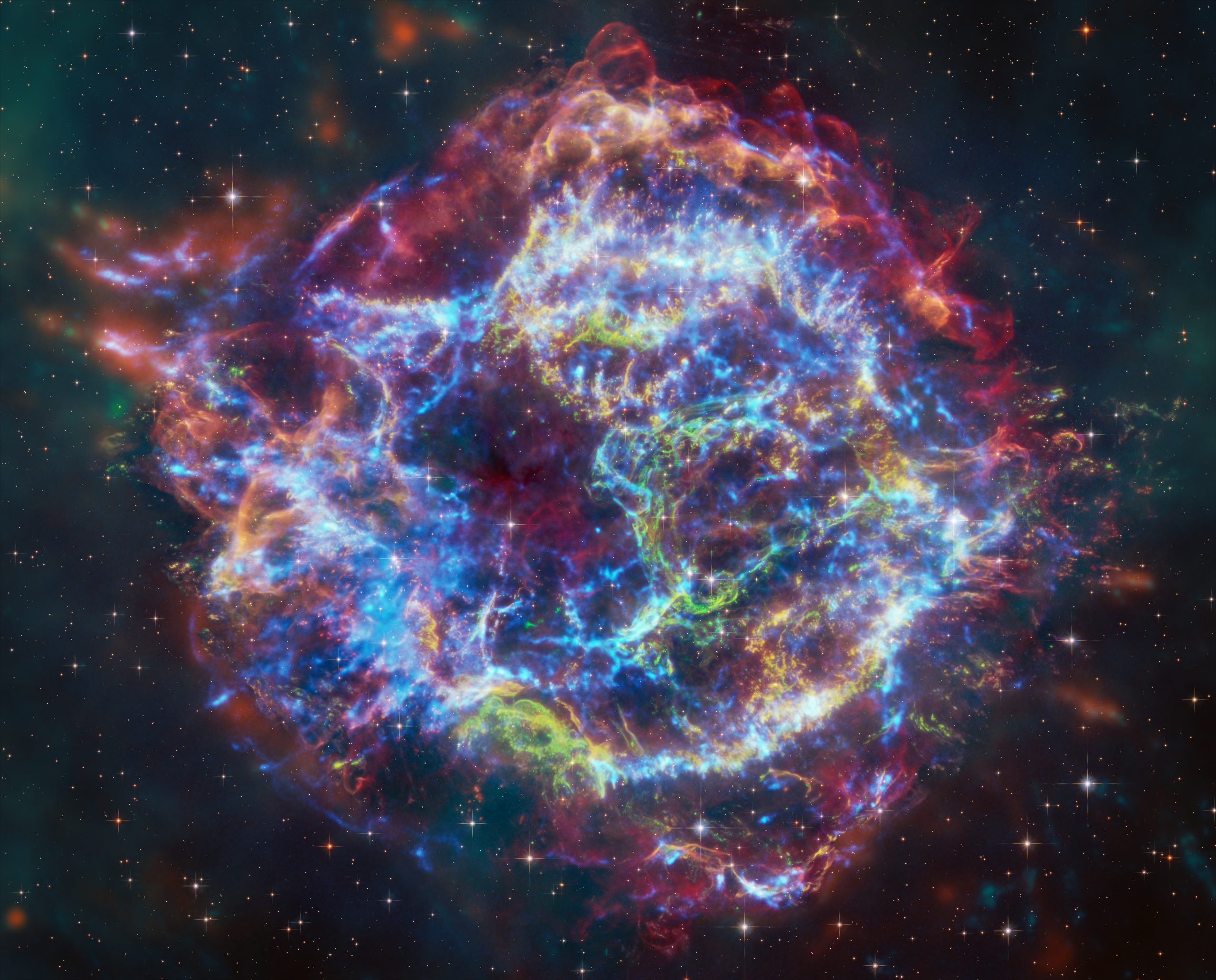
XRISM, 초신성 잔해 카시오페이아 A에서 염소와 칼륨 발견: 우주의 숨겨진 레시피를 밝히다 (XRISM Finds Chlorine, Potassium in Cas A: Unveiling the Universe’s Hidden Recipe)
Did you know that the very atoms that compose our bodies – the oxygen we breathe, the calcium in our bones, the iron in our blood – were likely forged in the fiery hearts of dying stars? Imagine, a cosmic connection so profound that it links us directly to the explosive deaths of stars billions of light-years away! Recently, the XRISM (X-Ray Imaging and Spectroscopy Mission) telescope has achieved a groundbreaking feat, firmly establishing its crucial role in XRISM 초신성 잔해 research: the definitive detection of chlorine and potassium within the supernova remnant Cassiopeia A (Cas A). This remarkable discovery, a testament to XRISM’s advanced X-ray spectroscopic capabilities, offers unprecedented insights into the fundamental processes of nucleosynthesis – the creation of elements inside stars – and the subsequent dissemination of these elements throughout the vast expanse of the cosmos. It marks a significant leap forward for XRISM 초신성 잔해 studies! Let’s embark on a journey to explore the intricate details of this exhilarating find and delve into its profound implications for our understanding of the universe’s origins and evolution. Are you ready to unravel some truly cosmic mysteries? Prepare for a deep dive into the heart of a stellar explosion!
🏆 Find Best ‘XRISM Finds Chlorine,’ on AliExpress
* Discover top-rated items at AliExpress
서론: 카시오페이아 A와 초신성 잔해 연구의 중요성 (Introduction: The Importance of Cassiopeia A and Supernova Remnant Research)
초신성 잔해, 즉 Supernova remnants, are the expansive, glowing remnants left behind after a massive star reaches the end of its life and explodes in a spectacular supernova. Think of it as the universe’s ultimate recycling program – a cosmic phoenix rising from the ashes! These remnants release an enormous amount of matter and energy into the surrounding space, scattering the diverse elements synthesized within the star’s core during its lifetime. These ejected elements become the raw materials for the formation of new stars, planets, and even, potentially, life itself. Therefore, the study of supernova remnants is of paramount importance in broadening our understanding of the universe’s intricate processes of stellar evolution and elemental cycling. Why is this critical? Because comprehending how elements are created and distributed allows us to unravel the mysteries of our own cosmic origins and place within the grand scheme of the universe. It’s about understanding where we come from, on a fundamental, atomic level!
카시오페이아 A (Cas A), or Cassiopeia A, is a relatively young supernova remnant located approximately 11,000 light-years away from Earth in the constellation Cassiopeia. Estimated to have exploded around the year 1680, its exceptional brightness makes it observable across a wide spectrum of electromagnetic radiation, including X-rays, visible light, and infrared radiation. Cas A has become a particularly important subject of study in X-ray astronomy because the high-temperature plasma within the remnant emits X-rays that provide valuable information about the presence, abundance, and spatial distribution of various elements. Imagine a celestial treasure chest, brimming with clues about the universe’s past and future!
XRISM is a cutting-edge X-ray observatory developed through a collaborative effort between the Japan Aerospace Exploration Agency (JAXA) and the National Aeronautics and Space Administration (NASA). Through X-ray spectroscopy, XRISM precisely analyzes the X-ray spectra emitted by celestial objects, enabling scientists to determine their temperature, density, chemical composition, and velocity. XRISM is equipped with an exceptionally high-resolution soft X-ray spectrometer that allows it to detect subtle spectral lines that were previously undetectable by older X-ray telescopes. This unparalleled spectroscopic capability positions XRISM at the forefront of supernova remnant research, promising to unlock new insights into these enigmatic cosmic phenomena. It’s akin to upgrading from a grainy, low-resolution photograph to a crystal-clear, high-definition image – the details become strikingly apparent! And because of this, XRISM 초신성 잔해 studies are poised to revolutionize our understanding of the final stages of stellar evolution and the creation of the elements that make up our universe.
XRISM: 새로운 눈으로 보는 카시오페이아 A (XRISM: Seeing Cassiopeia A with New Eyes)
The defining characteristic of the XRISM telescope is its exceptional spectral resolution. A spectrometer is an instrument that separates light into its constituent wavelengths for analysis. The soft X-ray spectrometer on board XRISM can measure X-ray spectra with unparalleled precision. This enables scientists to accurately identify the X-ray signals emitted by various elements within Cas A and determine the quantity and distribution of each element. But how does this incredible technology actually function? The spectrometer acts like a prism, separating light into its component colors (or in this case, X-ray wavelengths). The intensity of each wavelength reveals the presence and abundance of different elements. Think of it like analyzing a rainbow to determine the amount of each color present.
Previous X-ray observations primarily focused on analyzing the overall X-ray intensity or morphology. However, XRISM provides much more detailed spectral information, allowing scientists to precisely isolate the X-ray emissions from specific elements. For example, XRISM has successfully identified the faint X-ray spectral lines of chlorine and potassium, which were difficult to distinguish with previous telescopes. It’s a bit like being able to distinguish individual instruments in an orchestra, instead of just hearing the overall sound. Now the studies surrounding the XRISM 초신성 잔해 are far more detailed and nuanced. The ability to isolate specific element signatures allows astronomers to understand the specific conditions under which those elements were formed.
The innovative capabilities of XRISM can be summarized in the following table:
| ✅ Pros | ❌ Cons |
|---|---|
| 뛰어난 에너지 분해능으로 미세한 스펙트럼 선 식별 가능 (Excellent energy resolution allows identification of subtle spectral lines) | 관측 시간 제약으로 인해 전체 초신성 잔해를 상세하게 관측하기 어려움 (Observation time constraints make it difficult to observe the entire supernova remnant in detail) |
| 다양한 원소의 양과 분포를 정밀하게 측정 가능 (Precise measurement of the abundance and distribution of various elements) | 다른 파장(가시광선, 적외선) 관측 데이터와의 통합 분석 필요 (Integrated analysis with observation data in other wavelengths (visible light, infrared) is necessary) |
| 초신성 폭발 모델의 검증 및 개선에 기여 (Contributes to the verification and improvement of supernova explosion models) | 데이터 분석 및 해석에 고도의 전문성 요구 (Data analysis and interpretation require a high degree of expertise) |
| Enables more accurate measurements of plasma temperature and velocity within supernova remnants. | Data is subject to statistical uncertainties and requires careful calibration and validation. |
| Can map elemental abundance variations across the remnant to better understand the mixing and ejection of material during the supernova. | May be affected by background noise and contamination from other sources. |

염소와 칼륨의 발견: 의미와 함의 (The Discovery of Chlorine and Potassium: Meaning and Implications)
The analysis of XRISM data is an extremely complex process. Scientists must first refine the X-ray data collected by XRISM and remove background noise. They then analyze the X-ray emission spectra to identify which elements are present and the abundance of each element. In this study, scientists focused specifically on the X-ray emission spectra of chlorine and potassium, revealing that these two elements are present in significant quantities within Cas A. But why these elements specifically? Chlorine and potassium are considered relatively heavy elements that are created under very specific conditions during a supernova explosion. Their presence acts as a tracer, providing valuable information about the types of nuclear reactions that occurred and the conditions that prevailed during the stellar death.
The presence of chlorine and potassium provides important implications for supernova explosion models. A supernova explosion is a process that releases various elements created through nuclear fusion reactions inside a star into space. Chlorine and potassium belong to relatively heavy elements and can be created only under specific conditions during a supernova explosion. Therefore, XRISM’s discovery implies that the supernova explosion process may be more complex and diverse than we previously thought. Is it possible that our existing models are too simplistic to fully capture the complexity of these stellar events? This discovery suggests that we need to refine our understanding of stellar explosions and the nuclear processes that drive them. This is why the XRISM 초신성 잔해 research is fundamentally important to our theoretical models of the universe. The presence of these elements helps constrain the physical parameters used in the models, making them more realistic.
An intriguing aspect of this discovery is how these elements are dispersed throughout the universe. Supernova explosions generate immense shockwaves that propagate through the surrounding space, pushing away surrounding gas and dust and creating environments conducive to the birth of new stars and planets. The chlorine and potassium ejected by supernova explosions mix with the surrounding interstellar medium and eventually become the raw materials for the formation of new stars and planets. This means that the elements that make up our bodies may have been created in past supernova explosions. It’s a humbling thought, isn’t it? We are literally made of stardust, forged in the crucible of stellar death! This emphasizes the interconnectedness of the universe and the cyclical nature of matter.
다파장 관측: 찬드라, 제임스 웹, 허블의 협력 (Multi-Wavelength Observations: The Collaboration of Chandra, James Webb, and Hubble)
XRISM’s discovery gains even richer meaning when combined with observational data from other telescopes. NASA’s Chandra X-ray Observatory provides X-ray images of Cas A, helping to identify where the chlorine and potassium discovered by XRISM are distributed. Chandra’s high-resolution images reveal the complex structure within Cas A and, combined with XRISM’s spectroscopic information, enable a more accurate picture of the elemental distribution. Chandra, which was launched in 1999, provides complementary high-resolution X-ray images, highlighting the regions of hottest plasma and the shock fronts propagating through the remnant.
The James Webb Space Telescope (JWST) contributes to understanding the distribution of dust and gas within Cas A through infrared observations. JWST’s infrared data provides crucial information on where chlorine and potassium exist and how they interact with surrounding matter. JWST, launched in 2021, observes in the infrared, allowing scientists to see through the dust clouds that obscure visible light, revealing the distribution of molecules and the sites of ongoing star formation within the remnant.
The Hubble Space Telescope (HST) shows the overall shape and structure of Cas A through visible light observations. HST’s images clearly show Cas A’s shell and filament structures and, integrated with data from XRISM, Chandra, and JWST, help trace the history of supernova explosions. HST, launched in 1990, provides stunning visible light images, revealing the overall structure and morphology of Cassiopeia A, showcasing the complex interplay of gas, dust, and magnetic fields within the remnant.
These multi-wavelength observations are like assembling pieces of a puzzle. By comprehensively analyzing data observed by each telescope at different wavelengths, scientists can more completely understand the overall appearance and evolution of Cas A. How does combining these different perspectives help? By looking at different wavelengths, we can learn about different aspects of the supernova remnant. X-rays reveal the hot, energetic plasma, infrared reveals the dust and gas, and visible light reveals the overall structure. The studies on XRISM 초신성 잔해 data would become very robust when combined with the data from the three telescopes. It provides a holistic view of the supernova remnant, painting a complete picture of its physical and chemical state.
초신성 폭발과 원소 합성: 우주의 화학 공장 (Supernova Explosions and Element Synthesis: The Universe’s Chemical Factory)
Supernova explosions are one of the most dramatic events in the life cycle of a star. Stars that are much heavier than the Sun exhaust all internal nuclear fuel and collapse under gravity, causing an explosion. This explosion produces tremendous energy and synthesizes various elements. So, what exactly happens during a supernova? The core of the star collapses rapidly, triggering a powerful shockwave that rips through the star’s outer layers, creating new elements in the process and scattering them into space.
Understanding how elements are created during a supernova explosion is crucial. Inside a star, light elements such as hydrogen, helium, carbon, and oxygen are created through nuclear fusion reactions. However, elements heavier than iron cannot be created by normal nuclear fusion reactions. Supernova explosions are the only way to create these elements. In which type of fusion are heavy elements produced? Elements heavier than iron can only be produced in the extreme conditions of a supernova explosion through processes like the rapid neutron-capture process (r-process), which involves the rapid absorption of neutrons by atomic nuclei, leading to the creation of heavier elements.
The elements created during a supernova explosion are scattered into space, and these elements become the raw materials for new stars and planets. In other words, supernova explosions play a very important role in the universe’s material circulation process. By studying supernova remnants such as Cas A, we can more deeply understand the mechanisms of supernova explosions and the element synthesis process, and furthermore, gain insights into the origin and evolution of the universe. The next step for XRISM 초신성 잔해 studies would be understanding the chemical distribution and how it varies across the remnant. What other information can they reveal? These detailed studies would reveal the nature of the stellar progenitor, the explosion mechanisms, and the influence of the surrounding environment.
History and Technology Behind XRISM
Before XRISM, X-ray astronomy missions like Chandra and XMM-Newton provided invaluable data, but XRISM’s superior spectral resolution marks a significant advancement. The Resolve instrument on XRISM uses a micro-calorimeter spectrometer, which measures the tiny temperature changes caused by individual X-ray photons. This allows for extremely precise energy measurements, enabling the identification of faint spectral lines that would otherwise be lost in the noise. XRISM builds upon the legacy of previous missions like Suzaku, which also had X-ray spectrometers but lacked XRISM’s level of precision. The history of X-ray astronomy is marked by continuous technological improvements, pushing the boundaries of what is observable and knowable about the universe.
Here is the technology breakdown:
- Micro-calorimeter Spectrometer: Measures the minuscule temperature change caused by individual X-ray photons, providing ultra-precise energy measurements.
- High Energy Resolution: Allows the identification of very faint spectral lines, revealing the presence of trace elements and providing insights into the physical conditions of the observed object.
- Space Based Platform: Able to collect a great deal of light from the universe unimpeded by the Earth’s atmosphere. Also enables long, continuous observations.
- Advanced Cooling System: The micro-calorimeter spectrometer requires extremely low temperatures (fractions of a degree above absolute zero) to function properly, necessitating a sophisticated cooling system.

향후 연구 방향 및 전망 (Future Research Directions and Outlook)
XRISM is planning to conduct additional observations of various supernova remnants, including Cas A, in the future. The data obtained through additional observations will help refine supernova explosion models and contribute to a broader understanding of the element synthesis process. What are some specific questions that XRISM can help answer in the future? These can include the exact processes involved in heavy element formation, the distribution of different elements within the remnant, and the dynamics of the expanding plasma. Specifically, XRISM can help us understand if there are any asymmetries within the elemental distribution, providing key information regarding the mechanics of the supernova explosion.
The development of next-generation X-ray telescopes is also actively underway. Future X-ray telescopes will have much higher energy resolution and sensitivity than XRISM, allowing us to explore the deeper reaches of the universe and make new discoveries that we have never imagined. These telescopes would take studies on XRISM 초신성 잔해 to another level, providing unprecedented insights into the formation and evolution of galaxies, black holes, and other cosmic phenomena. One promising area of development is the use of X-ray interferometry, which combines the signals from multiple telescopes to achieve much higher angular resolution.
However, many challenges remain in supernova remnant research. For example, accurately predicting which elements will be created under what conditions during a supernova explosion is extremely difficult. Also, understanding how the elements ejected by supernova explosions interact with the surrounding environment and how they participate in the formation of new stars and planets is an important task. Furthermore, understanding the role of magnetic fields in shaping the structure and dynamics of supernova remnants remains a significant challenge.
결론: XRISM의 발견이 우리에게 주는 교훈 (Conclusion: The Lessons of XRISM’s Discovery)
The discovery of chlorine and potassium through XRISM’s Cas A observations is an important achievement that further advances our understanding of the universe. This discovery was possible thanks to the passion and dedication of scientists who are constantly striving to explore the mysteries of the universe. The successful execution of the XRISM project is a good example of the importance of international cooperation and demonstrates that scientific and technological advances can broaden the horizons of humanity. What is the biggest takeaway from XRISM’s findings? We are more intimately connected to the cosmos than we ever thought possible, and that the elements that make up our bodies were forged in the hearts of dying stars.
In the end, XRISM’s discovery teaches us the following lessons:
- 우주는 끊임없이 변화하고 진화하는 역동적인 공간이며, 그 안에는 우리가 아직 알지 못하는 수많은 비밀들이 숨겨져 있다. (The universe is a dynamic and ever-evolving place with countless secrets yet to be uncovered, waiting to be discovered through scientific exploration.)
- 과학적인 탐구와 기술적인 혁신은 우주의 비밀을 밝혀내고, 인류의 지식을 확장하는 데 필수적인 도구이다. (Scientific inquiry and technological innovation are essential tools for unlocking the universe’s secrets, expanding human knowledge, and improving the quality of life on Earth.)
- 국제적인 협력과 공동의 노력은 복잡하고 어려운 과학적인 문제들을 해결하는 데 매우 중요하다. (International collaboration and joint efforts are crucial for solving complex and challenging scientific problems, fostering mutual understanding, and promoting peace and progress among nations.)
- The universe is constantly recycling matter, and that the elements created in the supernova explosions are the building blocks for future generation of stars and planets.
In the future, we will continue to explore the mysteries of the universe through advanced observation equipment such as XRISM and expand our understanding of the universe. And these efforts will ultimately lead to a deeper understanding of ourselves and the world we live in. And who knows what amazing discoveries await us next? The future of XRISM 초신성 잔해 studies looks brighter than ever! Let’s continue to explore, discover, and inspire!


